
Taking Full Advantage Of Functionality of Clock Motors
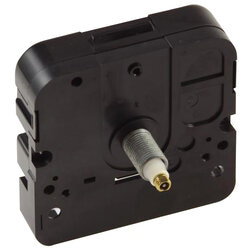
Clock motors manage the timekeeping and various other useful actions of timepieces. In today's globe, clock motors (or "activities" in the trade) are online powered, and a quartz crystal is the timing source, shaking at a high frequency and giving off a train of pulses, their count symmetrical for elapsed time. Thus, we have a modern way of maintaining time, equivalent in look from the older mechanical clocks; however, the modern activity runs largely in software application, permitting added attributes, some exotic and uncommon, to be applied relatively quickly, particularly when contrasted to their mechanical cousins.
Conventional clock motors were mechanically made and developed, the only practical method. A coiled spring or hanging weight provided potential power, which in turn was converted into kinetic energy by triggering a flywheel to rotate. Pendulums and escapements managed the frequency of rotation, resulting in a constant tick-tock at a properly fine-tuned speed of one second.
But the mechanical frameworks had cumbersome and large components, which restricted their capabilities and made it challenging to adjust them to extended or ingenious layouts. Hence, once it was found that by subjecting a quartz crystal to a voltage decline causes it to resonate and discharge pulses at a precise price, the tables were set for switching from a mechanical method to a digital one for keeping time. The schedule of digital memory also facilitated the shift to an extra digital operation.
Craftsmens of the past produced timepieces that exhibited striking results, but the effort was detailed, painstaking, and included innovative mechanical couplings to get the impacts to be compatible temporal occasions. And, because of this initiative became less and much less economical, it declined at some point into a lost art. Nevertheless, the modern programmable clock motor makes it very easy to mimic these historical impacts and even to accomplish greater ones.
Obviously, digital clocks (which are electronic) provide a different interface and stretch the ordinary duration (when whatever resets) by tracking the moon phase, the weekday, and the complete date. However something is lost in this all-digital interface, and the electric motors we explain here are basically analog (moving hands, standard clock dials, and so on), though with some solid-state circuitry. And yet they can reproduce the treasure wrist watches.
The quartz crystal pulse-train is so precise that timing is near precise, and simple neighborhood brings the speed to the realm of secs and minutes. In addition, it is straightforward to extend the size of the reset duration by growing its trigger moment. Put added information on the dial and add an additional hand to direct at that info, and the days of the week or the dates of the month are revealed in addition to regular time.
It is likewise as simple for the wrist watch to show the current degree of the tide. This is likewise a routine sensation, however based upon the lunar cycle of 24 hours and 50 minutes. You can locate clock electric motors that do this feature, either as a standalone item or incorporated with basic timekeeping.
Yet you can also get motions that track modifications in the weather condition (barometric pressure, moisture, or temperature). These changes are not routine, so the crystal is not the resource of the information presented; rather, sensing units take normal measurements, and their worths are exchanged a relative setting along a scale. The standard dial and hands are replaced with a solitary hand that turns backward and forward over the range printed in an arc along the area.
There are still more features that we can go over, such as constant sweep second hands, chimes, different cosmetic pendulums, and high-torque variations that allow one construct frameworks 3 feet throughout in size. But our area is used up. The viewers should currently have the basics and the understanding for making the most of the capability of clock motors.